
unMASC NDM Myotonia Symptom Checker: A new tool to raise public awareness of myotonia
Péréon Y1; Roddate M2; Dominguez-Gonzalez C3; Zozulya-Weidenfeller A4; Mongini T5
1. Reference Centre for Neuromuscular Disorders AOC, Filnemus, Euro-NMD, University Hospital, Nantes, France
2. Paula Stradiņa Klīniskā Universitātes Slimnīca, Neurology, Riga, Latvia
3. Reference Centre for Neuromuscular Disorders, Euro-NMD, imas12 Research Institute, 12 de Octubre Hospital, Madrid, Spain
4. Lupin EMEA, Zug, Switzerland
5. Neuromuscular Unit, EURO-NMD, Department of Neurosciences, University of Torino, Italy
Non-dystrophic myotonias (NDM) are rare muscle disorders (reported prevalence, 0.75−1.7 per 100,000 population). Awareness of NDM can be low: patients may endure symptoms without seeking help; non-specialist clinicians may not consider NDM in diagnostic workup. Suboptimal NDM awareness/management mean that it often takes years to obtain a diagnosis. During this latent period, key symptoms of NDM may go untreated. In particular, myotonia, the major manifestation of NDM, affects individuals differently depending on underlying chloride or sodium channelopathies. Nevertheless, myotonia is associated with stiffness and movement limitation, which can detrimentally affect daily living and quality of life. There is therefore an unmet need to improve NDM (and myotonia) recognition.
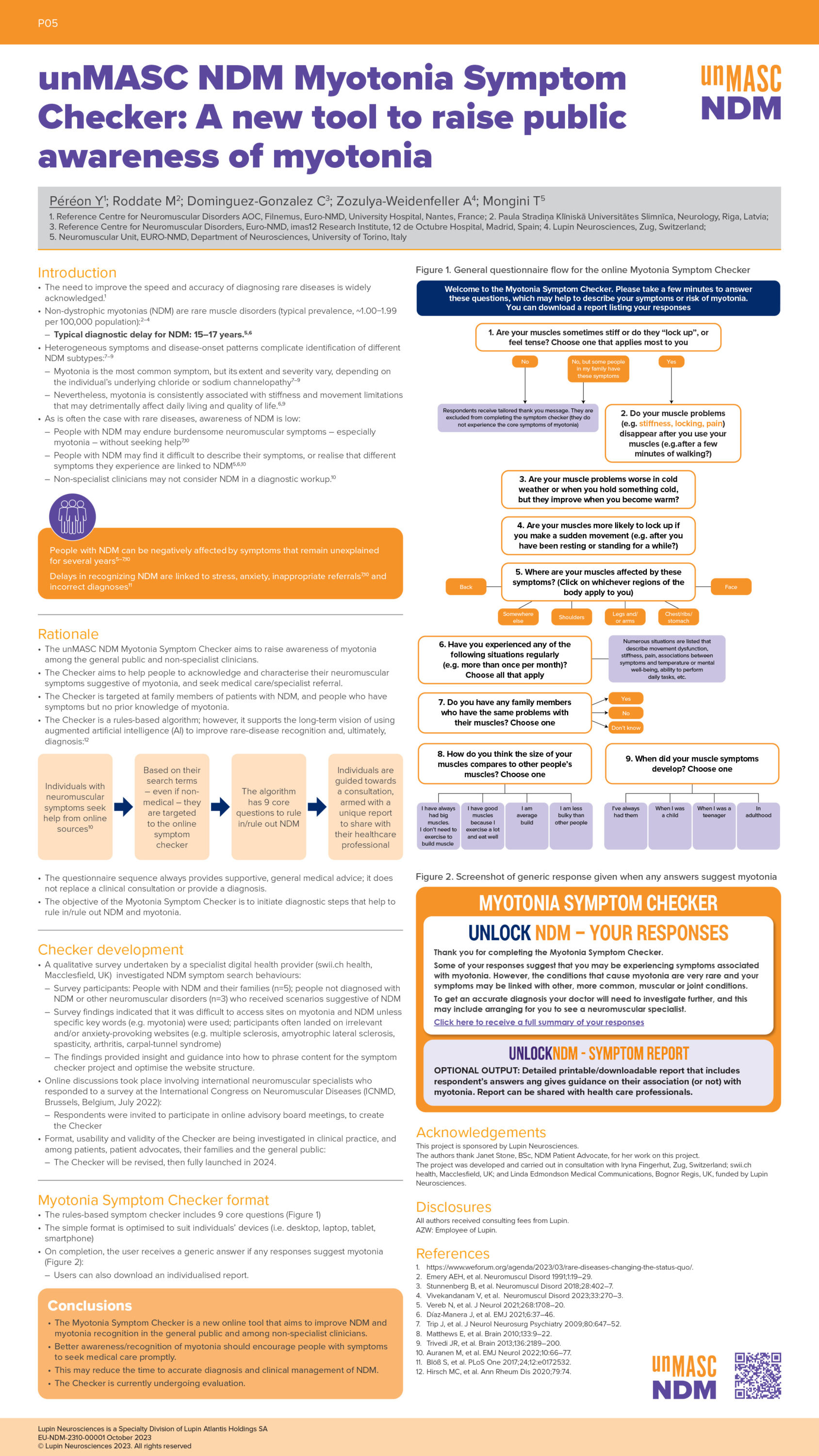
The unMASC NDM Myotonia Symptom Checker is a new online tool, developed to raise awareness of myotonia among the general public and non-specialist clinicians. The Checker aims to encourage people with myotonia to acknowledge their symptoms and seek medical care, initially via general practice consultations (with referral to neuromuscular disorder specialists, when relevant). The Checker is targeted at family members of people with NDM, or people with no prior knowledge of myotonia.
The Checker was developed following open discussion among neuromuscular specialists, then tested in clinical practice and online among patients and the general public. The Checker has nine core questions that broadly determine respondents’ symptoms and triggers. On completion, a report can be downloaded for sharing in clinical consultations but data are not stored. Development and testing of the Checker, and the questionnaire flow, are presented in the poster.

