
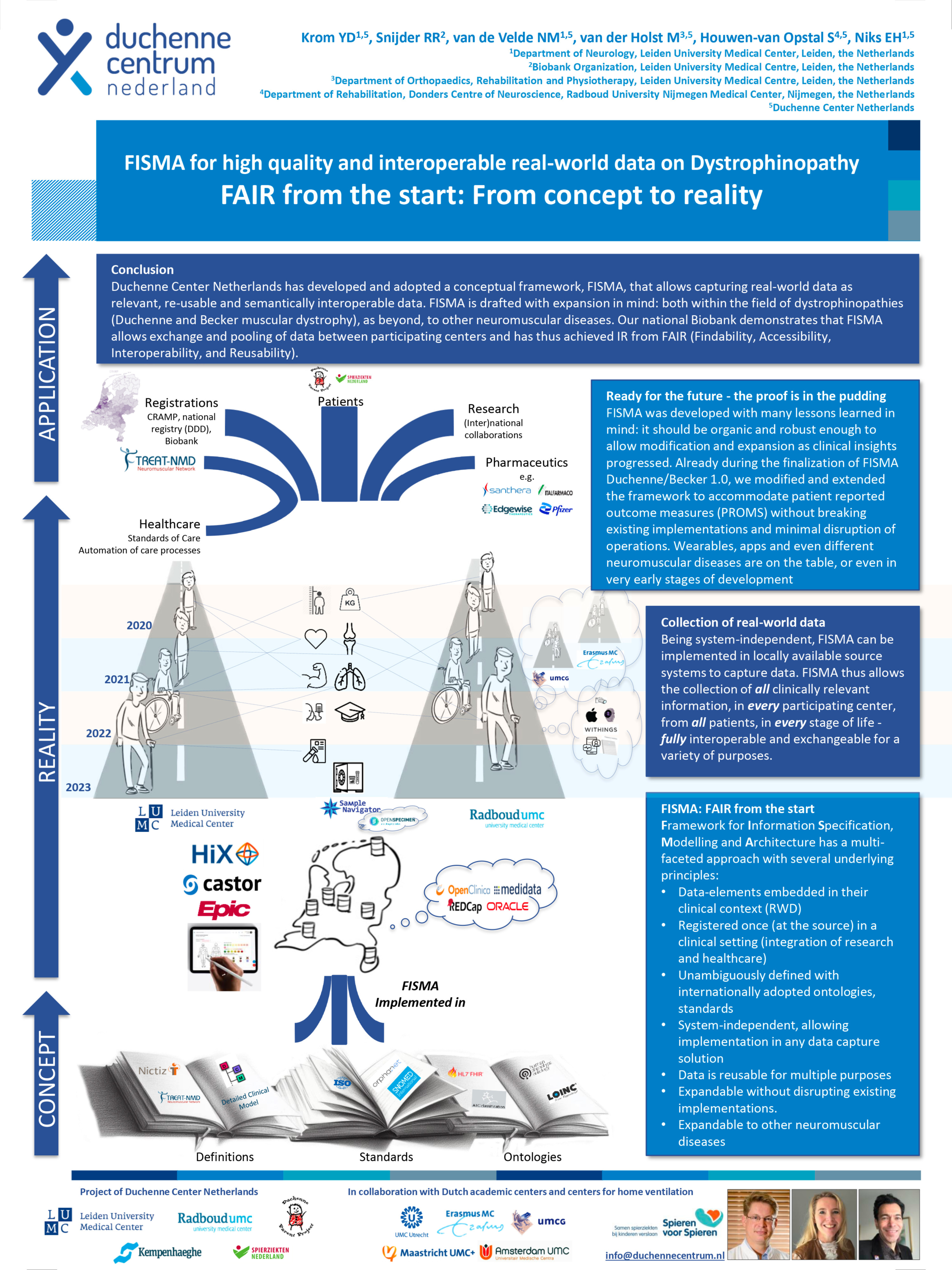
FISMA for high quality and interoperable real-world data on dystrophinopathy Fair form the start: From concept to reality
FAIR from the start: FISMA for high quality and interoperable real-world data on dystrophinopathy
Real-world healthcare data plays a pivotal role in better understanding and improving care for patients suffering from dystrophinopathies, a group of rare progressive X-linked neuromuscular disorders that includes Duchenne and Becker muscular dystrophy. It plays a crucial role in topics like the natural history, the economic impact of these diseases, as well as post-market safety and effectiveness of potential drugs. High-quality data from the start rather than post-hoc data curation is a significant driver to effectively use real-world data.
In Duchenne Center Netherlands, comprising two Dutch academic healthcare centers that treat patients with dystrophinopathies, we have embraced a holistic approach of fully integrating research and healthcare by making health care data intrinsically reusable and semantically interoperable. At the core is the Framework for Information Specification, Modelling and Architecture (FISMA) to bring all this information together.
FISMA is a framework with a multi-faceted approach with several underlying principles: data-elements should be embedded in their clinical context, registered once (registration at the source) in a clinical setting (integration of research and healthcare) without additional effort, unambiguously defined with internationally adopted ontologies, fully system-independent, allowing implementation in any data capture solution, reusable for multiple purposes, expandable to other phenotypes, as well as expandable with additional observations without disrupting existing implementations.
This poster presents an overview of the framework. Our other poster displays the implementation of FISMA in the Dutch Duchenne and Becker biobank, demonstrating that FISMA has met each principle, thus achieving semantic interoperability, or IR from FAIR (Findability, Accessibility, Interoperability, and Reusability).
From concept to reality: FISMA as a framework for the Dutch biobank for dystrophinopathies
High-quality, reliable data are crucially important to a biobank. Any sample only becomes truly meaningful, when it is embedded in a wealth of metadata, describing its clinical context: ideally, a digital snapshot of the patient at the time of collection.
The Dutch biobank for dystrophinopathies has, in close collaboration with an semantic interoperation information architect, developed and adopted a conceptual framework, FISMA – detailed in a separate poster. Being system-independent, FISMA allows every clinical observation by a health professional – e.g. nurse, physiotherapist, specialist – to become relevant, meaningful data, fit for a variety of purposes, and regardless of the underlying system, be it Epic, HiX, Castor, RedCap, or even an iPad Pro-app.
The biobank is an initiative of Duchenne Center Netherlands in collaboration with 5 university medical centers and 4 associated centers for home ventilation, all of which (will) collect biomaterials and health data according to mutually-agreed protocols. However, contrary to other multi-center endeavours, this biobank embraces registration at the source: FISMA makes health data reusable, interchangeable and interoperable, both for medical, scientific and registrational purposes.
In this poster, we provide you with an overview of the data exchanged between centers, as well as an impression what type of observations a digital snapshot at time of collection comprises.
Furthermore, it is detailed what opportunity FISMA brings in terms of future developments and expansions, both by adding new data sources – e.g. wearables, expanding or improving clinimetrics, or even broadening the scope to include other

