
Development of an auto-questionnaire to measure the impact of non-dystrophic myotonia on patients’ daily living and quality of life
Ahmed A1; Zozulya-Weidenfeller A2; Ezaru A1; Pini J1; Sacconi S1
1. Peripheral Neurology and Muscle Unit, Rare Neuromuscular Disease Reference Center, CHU Nice, Nice, France.
2. Lupin EMEA, Zug, Switzerland.
Non-dystrophic myotonia (NDM) presents with various symptoms, which differ in frequency and impact among individuals. Establishing the consequences of NDM for daily living and quality-of-life is important for planning/monitoring treatment. Although numerous validated instruments assess aspects of NDM, no disease-specific tools provide standardized, reproducible, patient-reported assessments across the spectrum of symptoms or disease course. We aimed to develop a questionnaire to evaluate the personal impact of NDM, to be completed by patients during routine consultations. The questionnaire aimed to identify key areas for clinical focus by providing a tool to support diagnostic/follow-up consultations, facilitate interpretations, and support decision-making regarding disease progression and treatment.
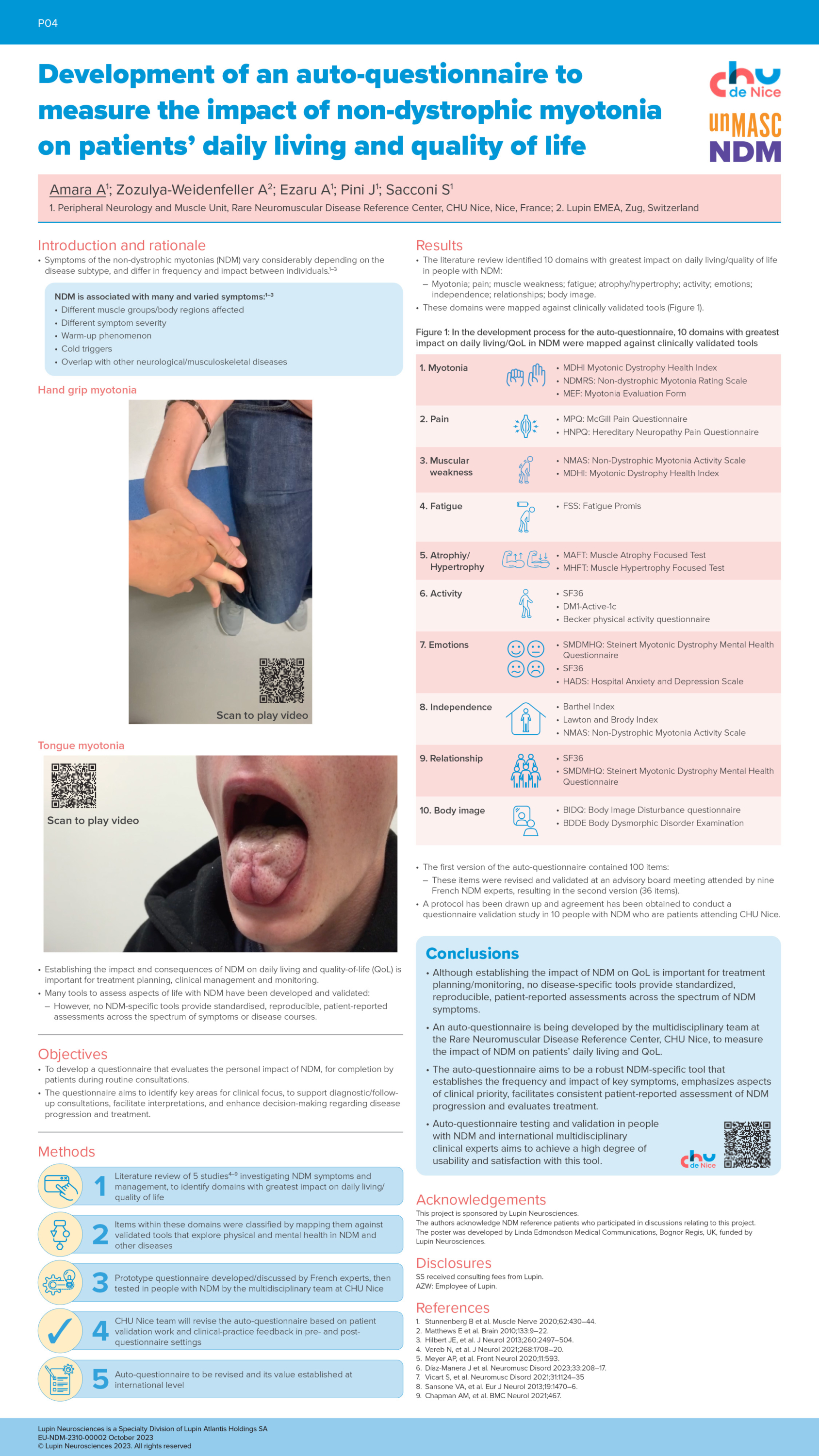
We conducted a literature review of five studies investigating NDM symptomatology and impact to develop the questionnaire. This identified 10 domains with the greatest effect on daily living and quality-of-life: myotonia, pain, muscle weakness, fatigue, atrophy/hypertrophy, activity, emotions, independence, relationships, and body image. Items within these domains were classified by mapping them against numerous validated tools that explore physical and mental health in NDM and other disease states.
A multidisciplinary team at CHU Nice developed a prototype NDM-specific questionnaire, which was tested in patients with NDM. International multidisciplinary clinical experts in NDM will further evaluate this tool. We aim to provide a robust NDM-specific tool that establishes the frequency and impact of key symptoms, emphasizes aspects of clinical priority, facilitates consistent patient-reported assessment of NDM progression and evaluates treatment. NDM clinical experts’ satisfaction with using such a questionnaire will also be measured. The poster reports initial findings.

