
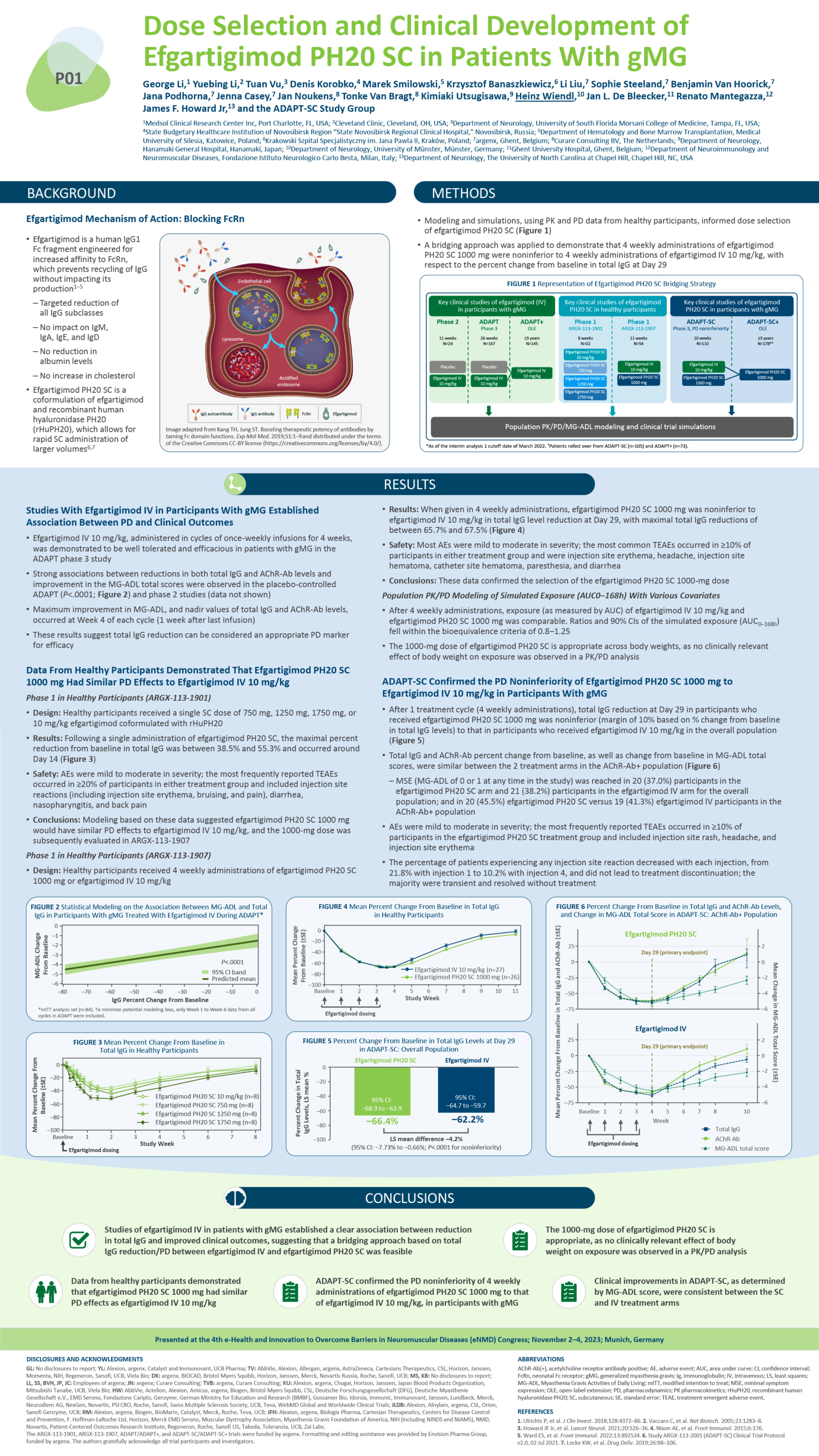
Dose selection and clinical development of efgartigimod PH20 subcutaneous (SC) in patients with generalized myasthenia gravis (gMG)
Authors: George Li,1 Yuebing Li,2 Tuan Vu,3 Denis Korobko,4 Marek Smilowski,5 Krzysztof Banaszkiewicz,6 Li Liu,7 Sophie Steeland,7 Benjamin Van Hoorick,7 Jana Podhorna,7 Jenna Casey,7 Jan Noukens,8 Tonke Van Bragt,8 Kimiaki Utsugisawa,9 Heinz Wiendl,10 Jan L. De Bleecker,11 Renato Mantegazza,12 James F. Howard, Jr,13 and the ADAPT-SC Study Group
Affiliations: 1Medsol Clinical Research Center Inc, Port Charlotte, FL, USA; 2Cleveland Clinic, Cleveland, OH, USA; 3Department of Neurology, University of South Florida Morsani College of Medicine, Tampa, FL, USA; 4State Budgetary Healthcare Institution of Novosibirsk Region “State Novosibirsk Regional Clinical Hospital,” Novosibirsk, Russia; 5Department of Hematology and Bone Marrow Transplantation, Medical University of Silesia, Katowice, Poland; 6Krakowski Szpital Specjalistyczny im. Jana Pawla II, Kraków, Poland; 7argenx, Ghent, Belgium; 8Curare Consulting BV, The Netherlands; 9Department of Neurology, Hanamaki General Hospital, Hanamaki, Japan; 10Department of Neurology, University of Münster, Münster, Germany; 11Ghent University Hospital, Ghent, Belgium; 12Department of Neuroimmunology and Neuromuscular Diseases, Fondazione Istituto Neurologico Carlo Besta, Milan, Italy; 13Department of Neurology, The University of North Carolina at Chapel Hill, Chapel Hill, NC, USA
Objectives
Confirm dose selection and rationale for using total immunoglobulin G (IgG) level reduction as a pharmacodynamic (PD) marker of noninferiority for SC efgartigimod PH20 (coformulated with recombinant human hyaluronidase PH20).
Materials and methods
Efgartigimod intravenous (IV) was evaluated in the phase 3 ADAPT study, where it demonstrated clinical efficacy and was well tolerated in patients with gMG. Based on observed associations between total IgG level reductions (including pathogenic autoantibodies) and MG-ADL improvements in the phase 2 study, a population PK/PD approach was utilized for efgartigimod PH20 SC dose selection, to provide a similar PD effect as efgartigimod IV (10mg/kg). PK/PD data from a phase 1 study where 32 healthy participants received a single efgartigimod PH20 SC injection at various fixed doses, including 10mg/kg, were analysed. Simulations were performed for a typical participant of 70kg, dose range:750–1750mg (25mg increments). The selected dose was evaluated in healthy participants and patients with gMG (ADAPT-SC study), as treatment cycles of 4-weekly injections.
Results
Efgartigimod PH20 SC 1000mg was predicted to comparably reduce total IgG on day 29, 1 week after the fourth injection, and was selected for the ADAPT-SC study. Patients weighing 42.0–150.2kg (median=78.3kg) received one treatment cycle of efgartigimod PH20 SC 1000mg and achieved total IgG reductions similar to those treated with efgartigimod IV 10mg/kg. These reductions were associated with MG-ADL improvements.
Conclusions
Dose selection was appropriate; treatment with efgartigimod PH20 SC 1000mg resulted in noninferior reduction in total IgG to efgartigimod IV 10mg/kg at day 29, irrespective of weight.

