
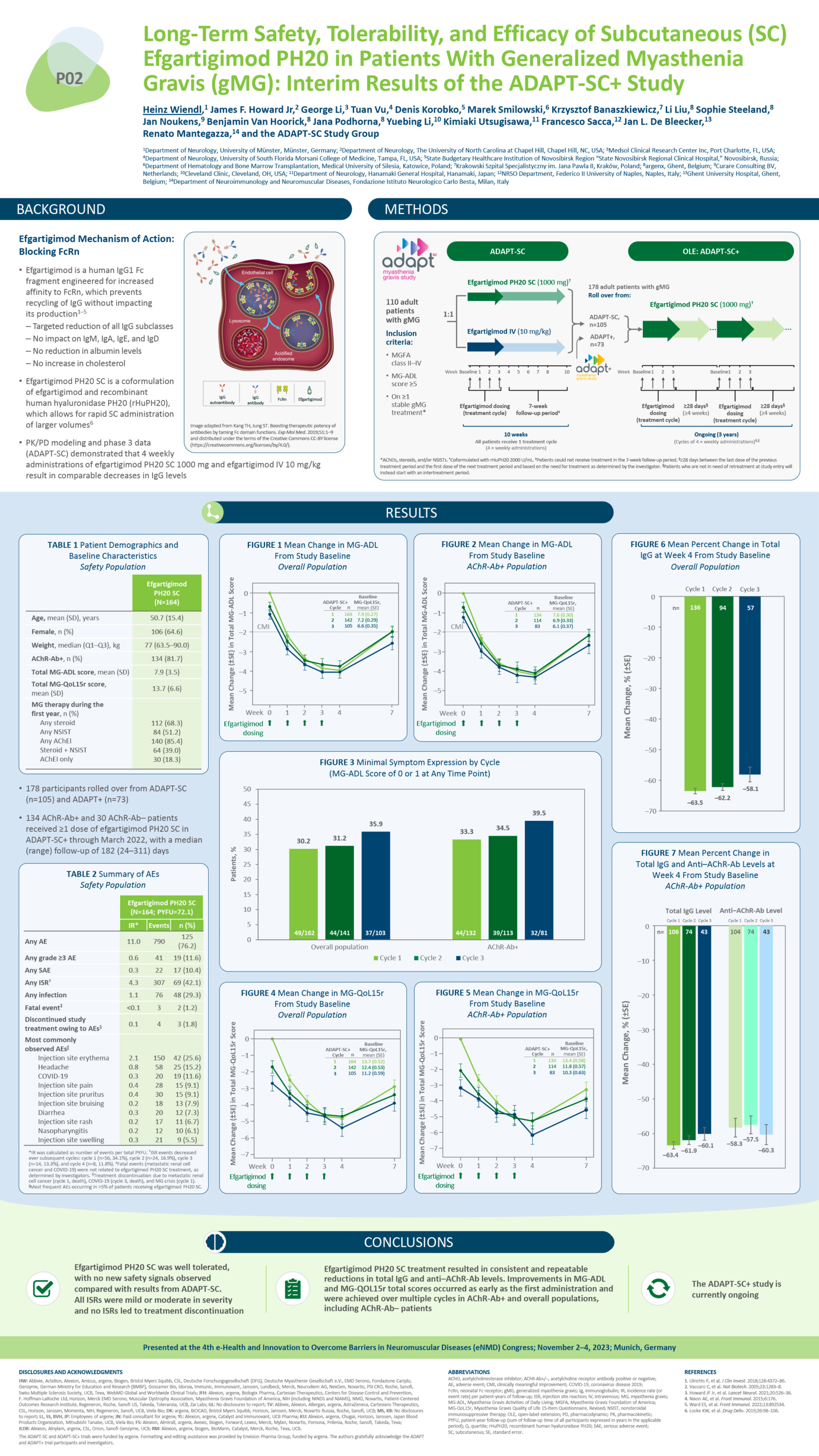
Long-term safety, tolerability, and efficacy of subcutaneous (SC) efgartigimod PH20 in patients with generalized myasthenia gravis (gMG): interim results of the ADAPT-SC+ study
Authors: Heinz Wiendl,1 James F. Howard, Jr,2 George Li,3 Tuan Vu,4 Denis Korobko,5 Marek Smilowski,6 Krzysztof Banaszkiewicz,7 Li Liu,8 Sophie Steeland,8 Jan Noukens,9 Benjamin Van Hoorick,8 Jana Podhorna,8 Yuebing Li,10 Kimiaki Utsugisawa,11 Francesco Sacca,12 Jan L. De Bleecker,13 Renato Mantegazza,14 and the ADAPT-SC Study Group
Affiliations: 1Department of Neurology, University of Münster, Münster, Germany; 2Department of Neurology, The University of North Carolina at Chapel Hill, Chapel Hill, North Carolina, USA; 3Medsol Clinical Research Center Inc, Port Charlotte, Florida, USA; 4Department of Neurology, University of South Florida Morsani College of Medicine, Tampa, Florida, USA; 5State Budgetary Healthcare Institution of Novosibirsk Region “State Novosibirsk Regional Clinical Hospital,” Novosibirsk, Russia; 6Department of Hematology and Bone Marrow Transplantation, Medical University of Silesia, Katowice, Poland; 7Krakowski Szpital Specjalistyczny im. Jana Pawla II, Kraków, Poland; 8argenx, Ghent, Belgium; 9Curare Consulting BV, The Netherlands; 10Cleveland Clinic, Cleveland, OH, USA; 11Department of Neurology, Hanamaki General Hospital, Hanamaki, Japan; 12NRSO Department, Federico II University of Naples, Naples, Italy; 13Ghent University Hospital, Ghent, Belgium; 14Department of Neuroimmunology and Neuromuscular Diseases, Fondazione Istituto Neurologico Carlo Besta, Milan, Italy
Objectives
Evaluate long-term safety, tolerability, and efficacy of efgartigimod PH20 SC (coformulated with recombinant human hyaluronidase PH20) in patients with gMG.
Materials and methods
In ADAPT-SC, efgartigimod PH20 SC was shown to have noninferior total IgG reduction to efgartigimod IV (approved in US, Japan, and EU) resulting in similar clinical improvement in patients with gMG. Patients completing ADAPT-SC, or enrolled in ADAPT+, were eligible for ADAPT-SC+ open-label extension study. Efgartigimod PH20 SC 1000mg was administered in cycles of 4-weekly injections. Subsequent cycles initiated ≥28 days from the last dose based on clinical evaluation. Efficacy was assessed utilizing the MG-ADL scale.
Results
As of March 2022, 164 participants received ≥1 efgartigimod PH20 SC dose. Patients received ~3 cycles over a mean study duration of 170 (SD:59) days (72 patient-years observation). Adverse events were predominantly mild/moderate; most frequent were injection site erythema (25.6%), headache (15.2%), and COVID-19 (11.6%). All injection site reactions were mild/moderate without requiring treatment discontinuation, occurred within 24 hours, resolved spontaneously, and incidence decreased with subsequent cycles. Two deaths were reported: metastatic renal cancer and COVID-19; neither deemed efgartigimod-related per investigator. MG-ADL total score (mean[SE] improvement from cycle baseline to week 4: –4.0 [0.25]), with consistent, repeatable improvements in subsequent cycles. Speed of onset, magnitude, and repeatability of improvements in MG-ADL were similar to those with efgartigimod IV during ADAPT/ADAPT+.
Conclusions
Results suggest multiple cycles of efgartigimod PH20 SC was well tolerated, with no safety concern identified. Observed safety/efficacy profile was consistent with efgartigimod IV.

