
Development of AUTOMA 2.0: an innovative wearable platform to assess the muscular activity of patients affected by Neuromuscular Disorders
Andrea Vannini1, Roberto Lazzarini1, Mario Milazzo2, Francesco Sansone3, Guja Astrea4, Silvia Frosini4, Francesca Torri5, Roberto Chiappini5, Giulia Ricci5, Gabriele Siciliano5, Filippo Maria Santorelli4, Raffaele Conte3, Stefano Roccella1
1 The BioRobotics Institute, Scuola Superiore Sant’Anna, Livorno, Italy
2 The BioRobotics Institute, Scuola Superiore Sant’Anna, Pontedera, Pisa, Italy
3 Institute of Clinical Physiology, National Research Council of Italy (IFC-CNR), Pisa, Italy
4 IRCCS Stella Maris Foundation, Calambrone, Italy
5 Pisa University Hospital, Pisa, Italy
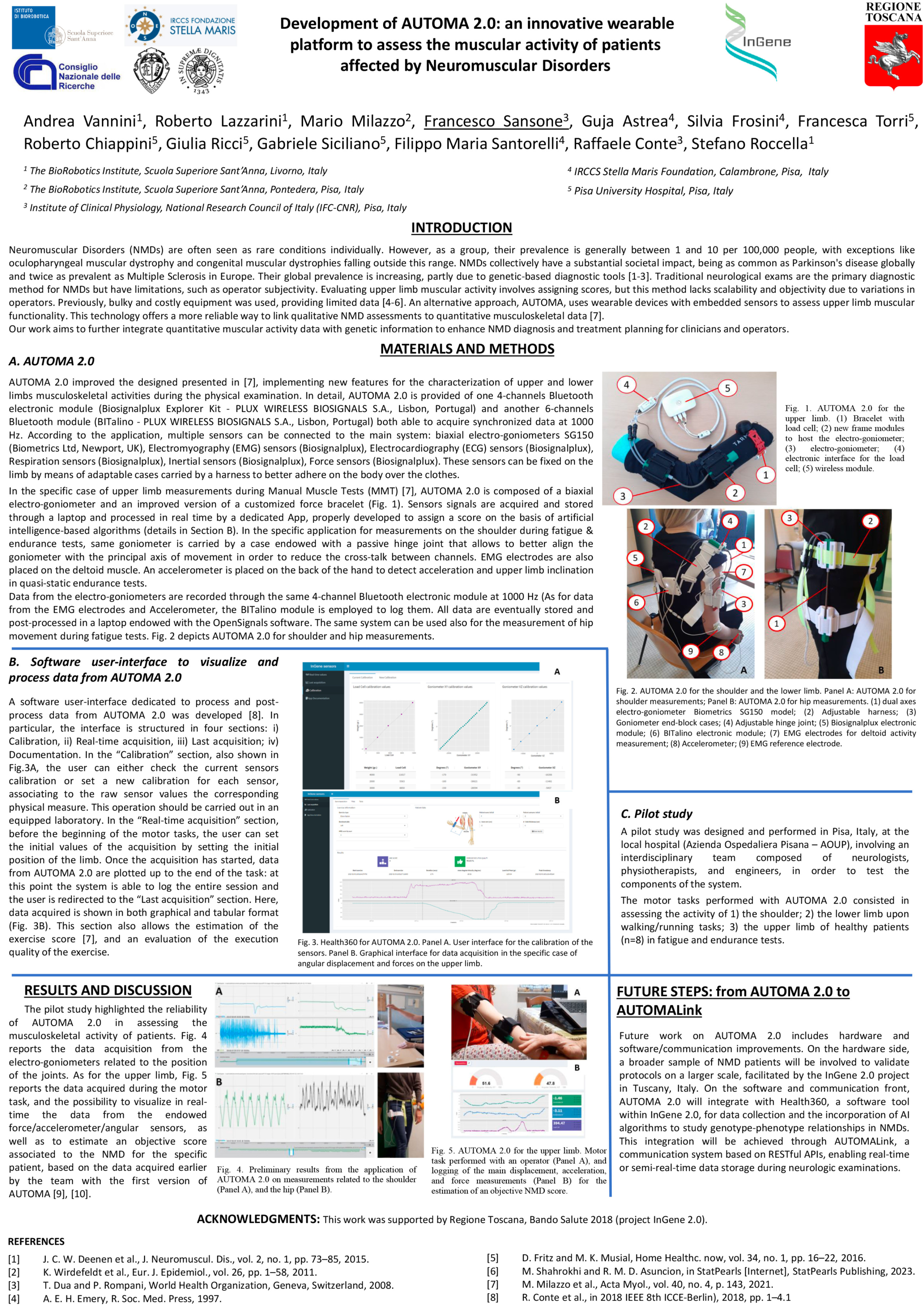
Neuromuscular disorders (NMDs) are conditions that have a high incidence in the population worldwide. The current approach to assess the muscular activity of the limbs consists in qualitatively evaluating the performance of a patient upon manual exercises guided by a specialized operator, or in employing bulky and costly medical instruments with limited flexibility towards different condition grades. AUTOMA 2.0 is a wearable device that overcomes the limitations of the traditional approaches, and provides an objective and quantitative assessment of functionality of the upper/lower limb muscles. AUTOMA 2.0 is composed of: a custom force bracelet to measure external force inputs imposed by physiotherapist, biaxial angular goniometers to measure the relative rotation of the limbs, and a module to perform electromyographic measurements. A textile sleeve and a polymeric harness are used to assemble the devices and to enhance the wearability. Data can be transmitted up to 1000 Hz to a local computer through a Bluetooth module for an online/offline processing. A software application based on AI algorithms processes data in real time and objectively quantifies the grade of impairment. A pilot study, recently conducted at the local hospital in Pisa (Italy)was carried out to calibrate and validate the instrumentation: AUTOMA 2.0 was tested by an interdisciplinary team that found it able to provide a precise and quantitative evaluation of the muscular activity, thus giving the possibility to better diagnose a potential NMD and to provide a more targeted therapy to treat the condition.
Acknowledgment: The present work was supported by the project InGene 2.0, funded by the Tuscany Region under the Bando Salute 2018.

