Application of digital tools in a management model for transition phase from paediatric to adult care in dystrophinopathies
Francesca Torri1, Alessandro Tonacci4, Francesco Sansone4, Michele Sacchini2, Chiara Ticci2, Guja Astrea3, Roberta Battini3, Roberto Chiappini1, Gabriele Vadi1, Raffaele Conte4, Giulia Ricci1, Gabriele Siciliano1
1 Department of Clinical and Experimental Medicine, University of Pisa, Pisa, Italy
2 Metabolic and Hereditary Diseases Unit, Meyer Hospital, Firenze, Italy
3 IRCCS Stella Maris, Calambrone, Pisa, Italy
4 Institute of Clinical Physiology, National Research Council of Italy (IFC-CNR), Pisa, Italy
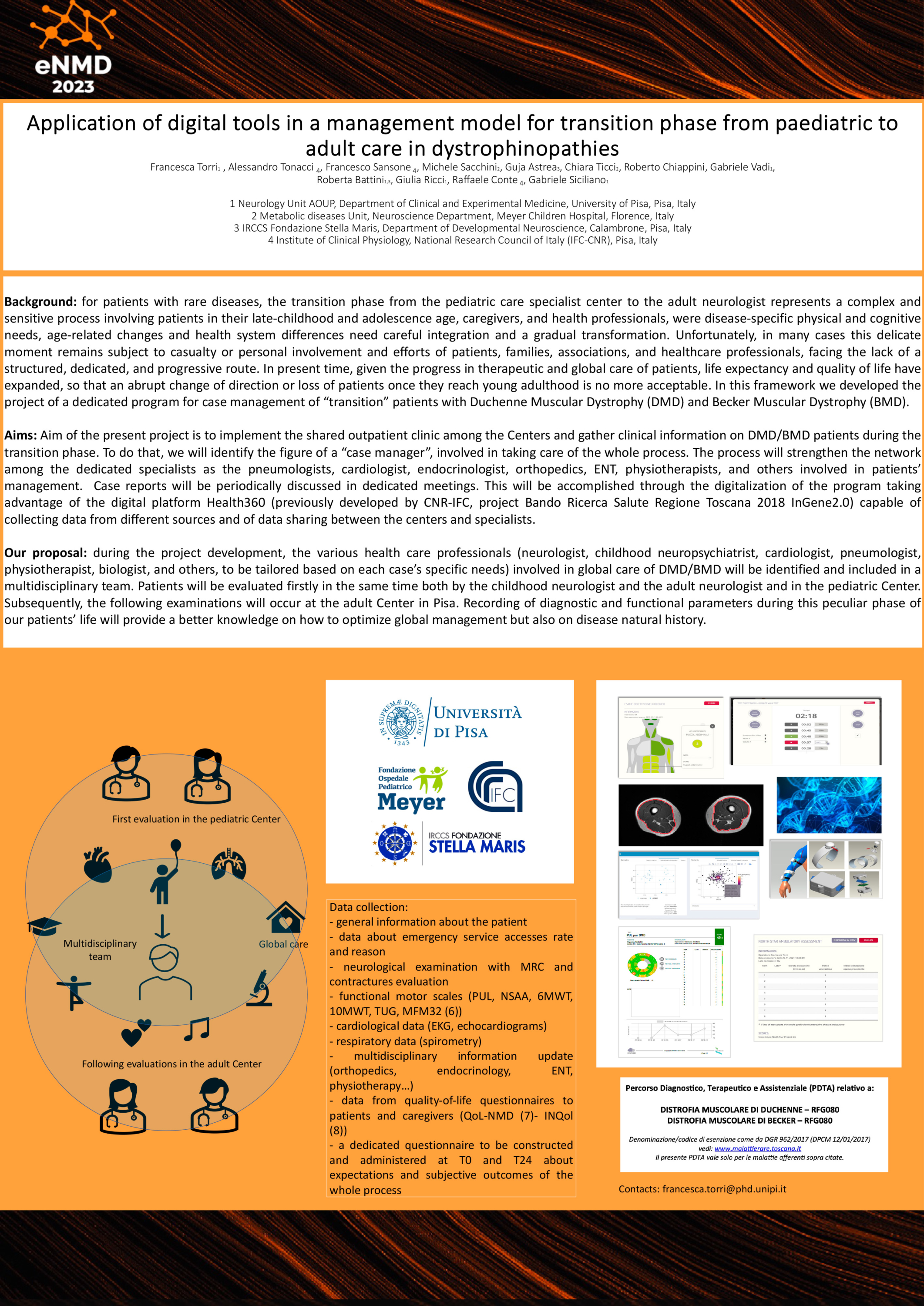
The transition phase from the pediatric care specialist center to the adult neurologist represents a complex and sensitive process involving patients in their late-childhood and adolescence age, caregivers, and health professionals. In this framework we developed the project of a dedicated program for case management of “transition” patients with Duchenne and Becker Muscular Dystrophy (DMD/BMD) in Tuscany region, involving the Neurology Unit from University of Pisa, responsible for adult patients, and the Metabolic and Hereditary Diseases Unit of Meyer Hospital and Neurology and Rare Diseases Unit of IRCCS Stella Maris for pediatric patients. We plan to include in a period of three years an estimated number of 25 DMD/BMD patients. Various health care professionals will be identified and included in the dedicated multidisciplinary team. Patients will be evaluated by the adult neurologist and the childhood neurologist in the pediatric Center on bimonthly-scheduled visits, and then the following examinations will happen in the adult Center in Pisa. Starting from the present collaboration between the Neurology Unit and the CNR Center from Pisa on the development and use of the digital application Health360 in phenotyping neuromuscular patients, the whole process will take advantage of a dedicated common platform to collect and share relevant clinical data between the multidisciplinary team members, in order to evaluate the role of IT in supporting data collection and management in this delicate clinical moment. We believe that recording of diagnostic and functional parameters during this peculiar phase of our patients’ life will provide a better knowledge on how to optimize global management but also on disease natural history.

