
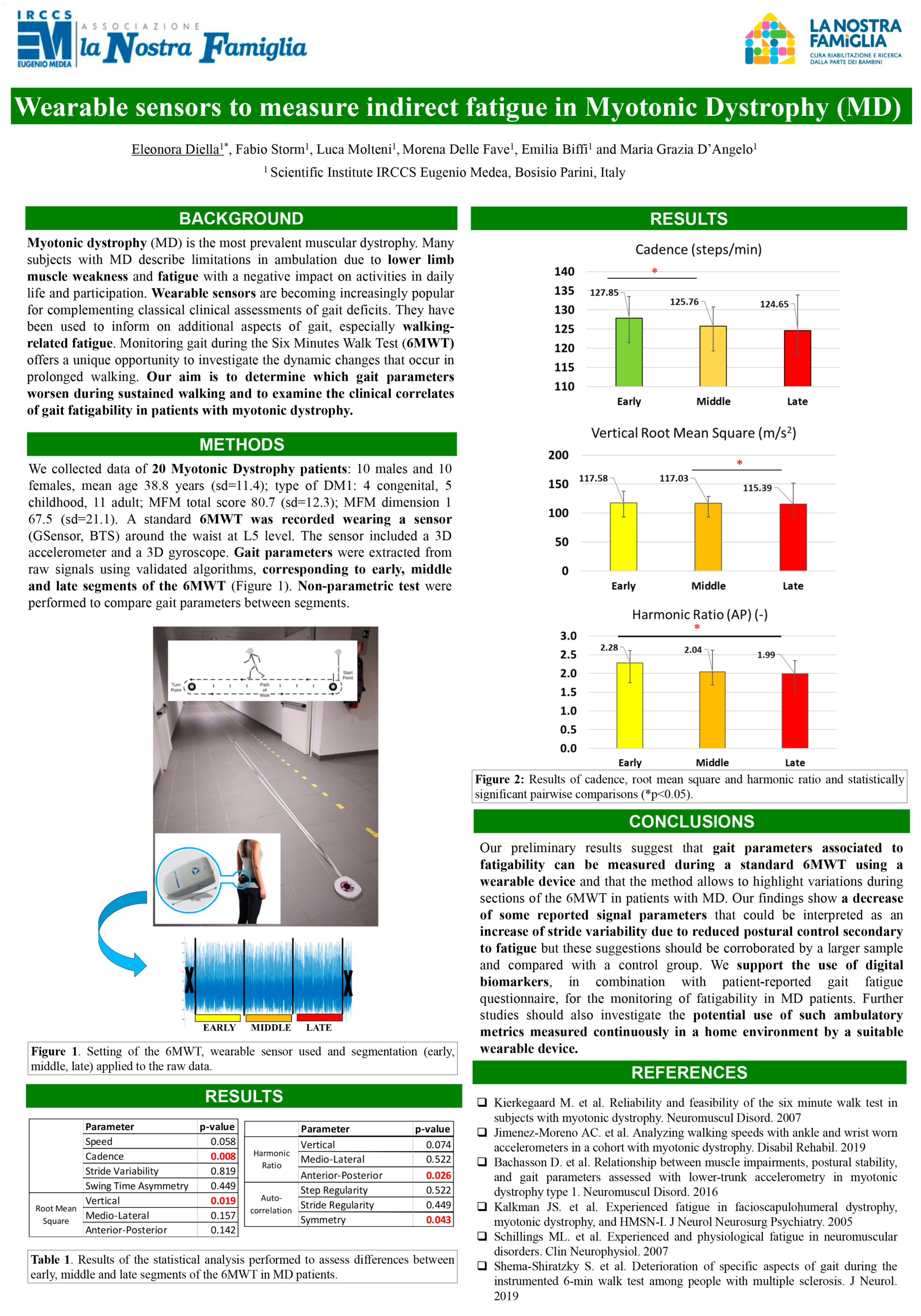
Wearable sensors to measure indirect fatigue in Myotonic Dystrophy (MD)
Eleonora Diella1*, Fabio Storm1, Luca Molteni1, Morena Delle Fave1,
Emilia Biffi1 and Maria Grazia D’Angelo1
1 Scientific Institute IRCCS Eugenio Medea, Bosisio Parini, Italy
Background: Wearable sensors are becoming increasingly popular for complementing classical clinical assessments of gait deficits. They have been used to inform on additional aspects of gait,
especially walking-related fatigue. Monitoring gait during the 6MWT offers a unique opportunity to investigate the dynamic changes that occur in prolonged walking. We try to determine which gait parameters worsen during sustained walking and to examine the clinical correlates of gait fatigability in patients with myotonic dystrophy.
Methods: Eleven patients with myotonic dystrophy were enrolled and recruitment is ongoing. Data were collected during a standard 6MWT wearing a sensor (GSensor, BTS) around the waist at L5 level. The sensor included a 3D accelerometer and a 3D gyroscope. Gait parameters were extracted from raw signals using validated algorithms, corresponding to early, middle and late segments of the 6MWT. Non-parametric test were performed to compare gait parameters between segments.
Results: Preliminary results show an increase in gait acceleration and significant changes in smoothness and stability of gait in the MD group between the early and the late section of the 6MWT.
Conclusions: Our preliminary results suggest that gait parameters associated to fatigability can be measured during a standard 6MWT using a wearable device and that the method allows to highlight variations during sections of the 6MWT in patients with Myotonic Dystrophy. These findings can be used, in combination with patient-reported gait fatigue, as markers for fatigability in MD patients.
*Presenting author
Eleonora Diella
Scientific Institute IRCCS E.Medea
Bosisio Parini, Lecco (Italy)
E-mail: eleonora.diella@lanostrafamiglia.it

