
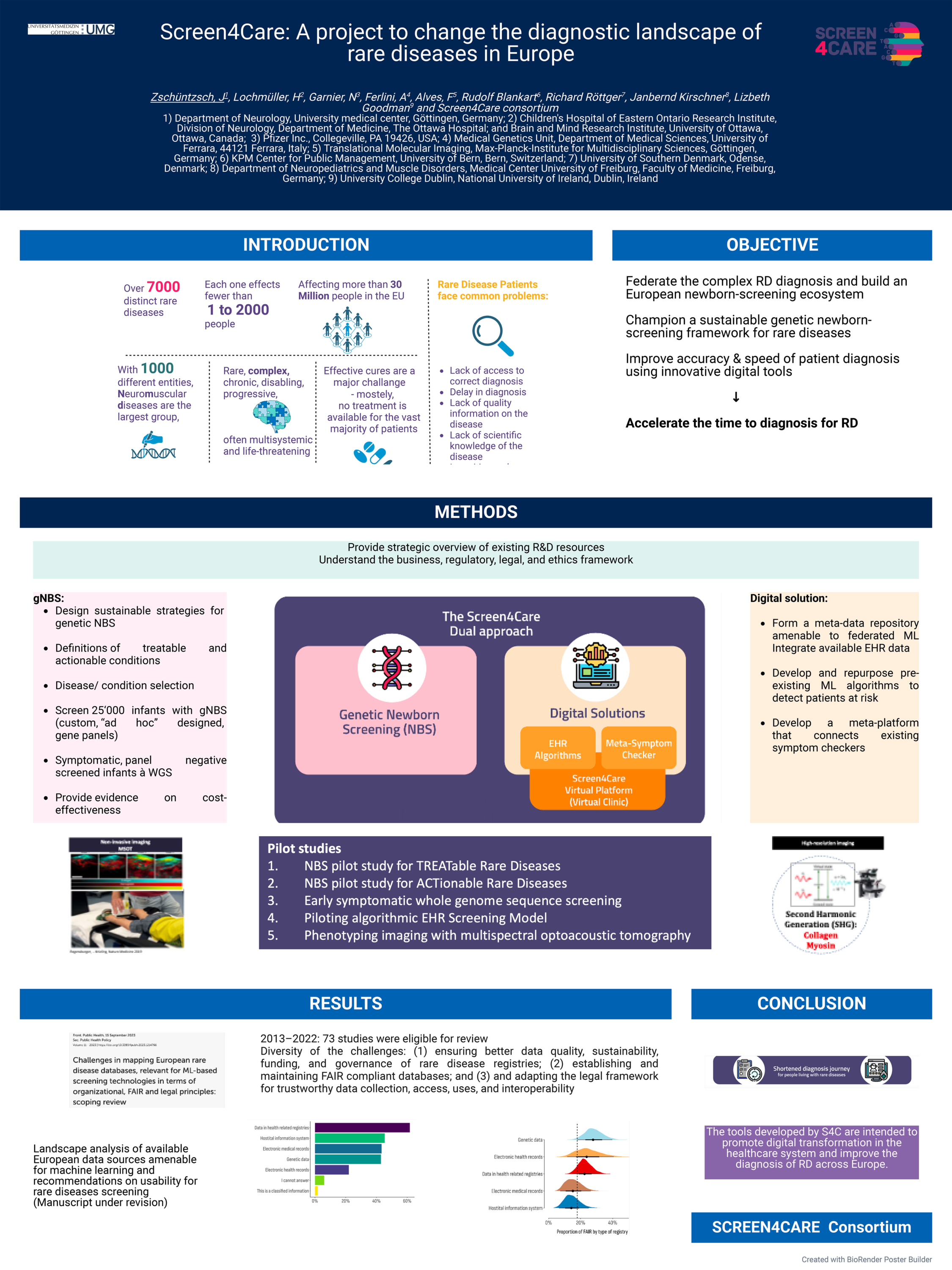
Screen4Care: A project to change the diagnostic landscape of rare diseases in Europe
Screen4Care: A project to change the diagnostic landscape of rare diseases in Europe
Authors: Zschüntzsch, J1, Lochmüller, H2, Garnier, N3, Ferlini, A4, Alves, F5,, Rudolf Blankart6 , Richard Röttger7 , Janbernd Kirschner8, Lizbeth Goodman9 and Screen4Care consortium
1) Department of Neurology, University medical center, Göttingen, Germany
2) Children’s Hospital of Eastern Ontario Research Institute, Division of Neurology, Department of Medicine, The Ottawa Hospital; and Brain and Mind Research Institute, University of Ottawa, Ottawa, Canada
3) Pfizer Inc., Collegeville, PA 19426, USA.
4) Medical Genetics Unit, Department of Medical Sciences, University of Ferrara, 44121 Ferrara, Italy.
5) Translational Molecular Imaging, Max-Planck-Institute for Multidisciplinary Sciences, Göttingen, Germany
6) KPM Center for Public Management, University of Bern, Bern, Switzerland
7) University of Southern Denmark, Odense, Denmark
8) Department of Neuropediatrics and Muscle Disorders, Medical Center University of Freiburg, Faculty of Medicine, Freiburg, Germany
9) University College Dublin, National University of Ireland, Dublin, Ireland
Background:
There are over 7000 rare diseases (RD), resulting in 30 million people living with RD in Europe. Early diagnosis and provision of effective treatments for RD have been identified as two of the greatest global health challenges of the 21st century. To move one step closer to early diagnosis of RD, the Screen4Care (S4C) public-private consortium was launched in October 2021 under the Innovative Medicines Initiative (IMI 2 JU). The main goal of S4C is to accelerate the diagnosis of RD.
Methods: Shortening the pathway to diagnosis for RD will be explored and addressed through three major approaches: i) mapping of existing resources and initiatives in the field of RD, ii) development and implementation of genetic newborn screening, iii) application of artificial intelligence to phenotypic detection of RD.
Results/Project Structure:
S4C is divided into five major pillars.
1: Analysis of the strategic landscape – understanding the business, ethical and legal environment for RD screening in Europe.
2: Establishment of federated meta-data repositories, to ensure maximum utility of scattered medical data while maintaining privacy according to FAIR principles.
3: Genetic NBS through the use of next-generation sequencing.
4: Machine learning algorithms on electronic health records for early diagnosis discovery.
5: Symptom Checkers and Virtual Clinics: this will connect existing symptom checkers for RD and curate the recommendations there.
Conclusions:
The tools developed by S4C are intended to promote digital transformation in the healthcare system and improve the diagnosis of RD across Europe.

