
Wearable-devices assisted clinical protocol for assessment of fatiguability in SMA
Giulia Ricci1, Stefano Roccella2, Francesca Torri1, Roberto Chiappini1, Alessandro Tonacci3, Francesco Sansone3, Raffaele Conte3, Gabriele Siciliano1
1. Department of Clinical and Experimental Medicine, University of Pisa, Pisa, Italy
2. The Biorobotics Institute, Sant’Anna Superior Studies School, Pisa, Italy
3. Institute of Clinical Physiology, National Research Council of Italy (IFC-CNR), Pisa, Italy
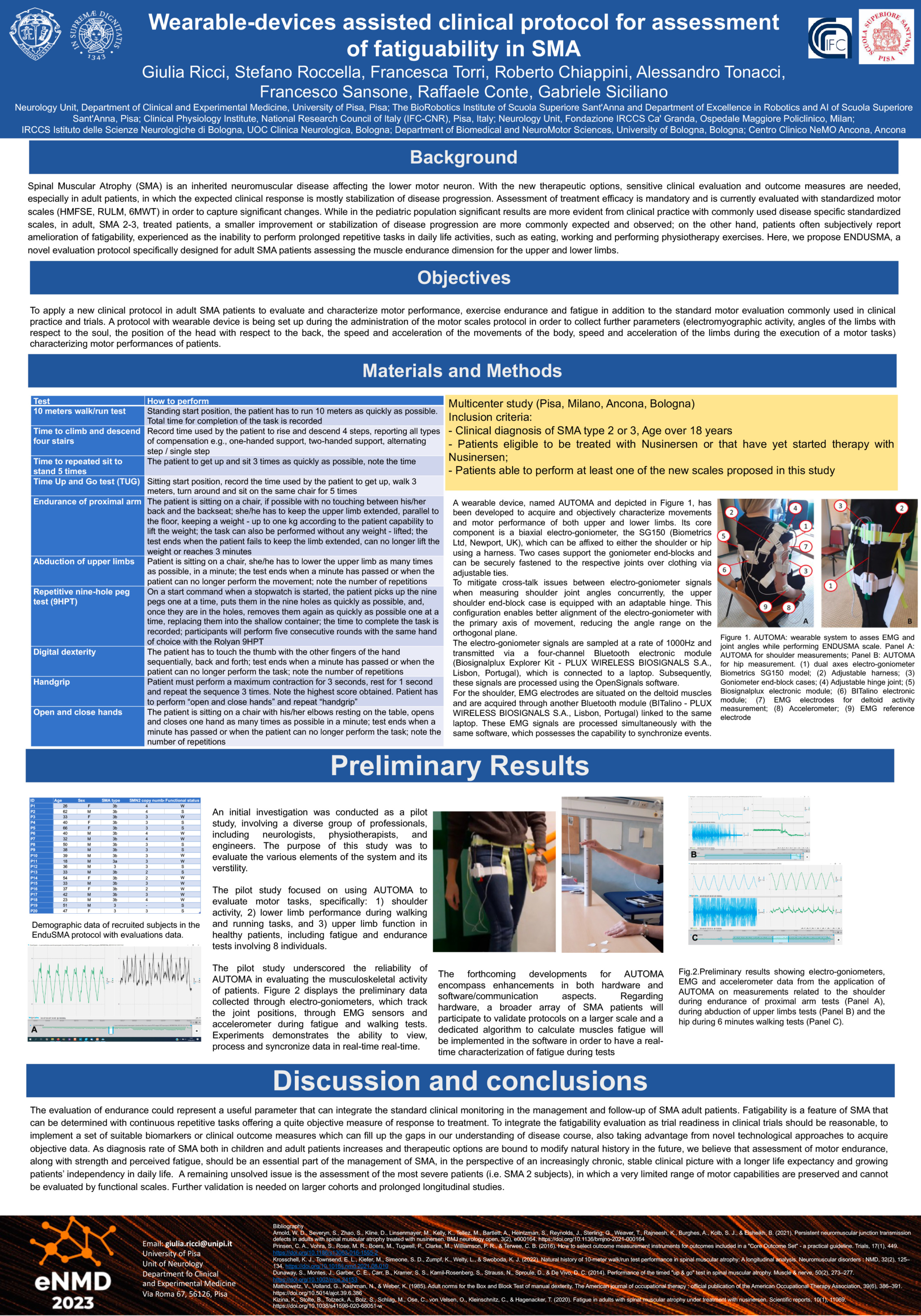
Spinal Muscular Atrophy (SMA) is an inherited neuromuscular disease affecting the lower motor neuron. With the new therapeutic options, sensitive clinical evaluation and outcome measures are needed, especially in adult patients, in which the expected clinical response is mostly stabilization of disease progression. With treatment, patients often subjectively report amelioration of fatigability in daily life activities. Based on this, we developed a dedicated evaluation scale, ENDUSMA, as an evaluation tool specifically designed for adult SMA patients assessing the muscle endurance dimension for the upper and lower limbs.To enhance the sensitivity of the scale to capture changes in patients’ endurance during motor tasks, a wearable devices protocol (AUTOMA) composed of one biaxial electro-goniometer and a surface electromyographer has been applied during the administration of the motor scales protocol. The system has been tested on two SMA patients so far. Electro-goniometer signals are acquired at 1000Hz by a 4 channels Bluetooth electronic module connected to a laptop; for the shoulder, EMG electrodes are placed on the deltoid and are acquired by another Bluetooth module connected to the same laptop. EMG signals are simultaneously processed with the same software that can synchronize events.
The endurance clinical evaluation supported by the AUTOMA acquisition system can integrate the standard clinical monitoring in the follow-up and in evaluating response to treatment in SMA adult patients.

