
Innovation in Treatment of Generalized Myasthenia Gravis: From Trial Design to Real-World Clinical Practice
Andreas Meisel,1 Kathy Perez,2 Cynthia Qi,2 Filip Callewaert3
1. Charité – Universitätsmedizin Berlin, Berlin, Germany (andreas.meisel@charite.de); 2. argenx, Boston, MA, USA; 3. argenx, Ghent, Belgium
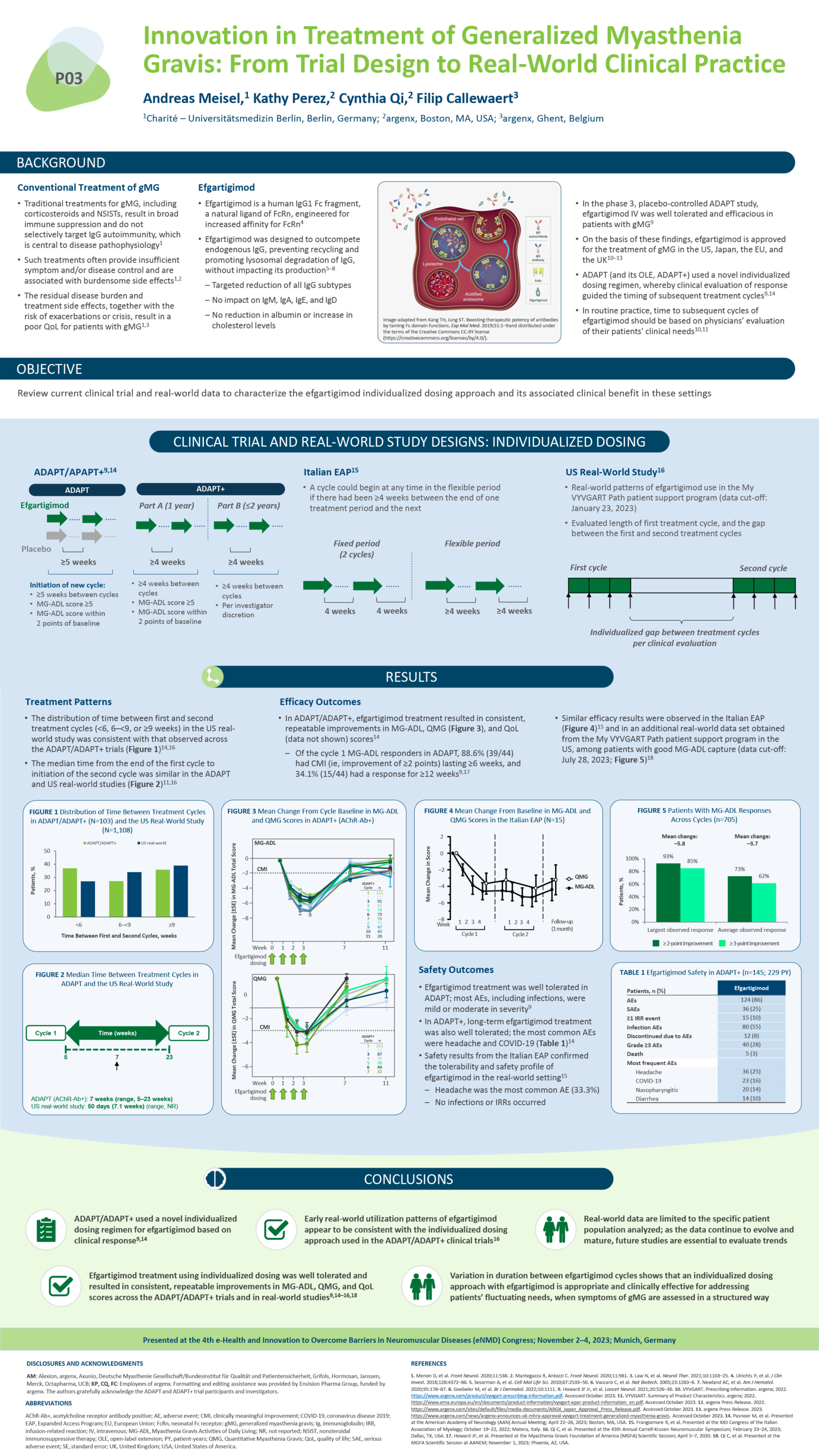
Background: Traditional generalized myasthenia gravis (gMG) treatments often provide insufficient symptom/disease control with burdensome side effects. Efgartigimod, a human IgG1 Fc fragment, reduces total IgG, including pathogenic autoantibody levels, via neonatal Fc receptor blockade. Efgartigimod demonstrated tolerability/efficacy in the phase 3 ADAPT trial and is approved in the US/Japan/EU/UK for gMG treatment. ADAPT (and its open-label extension, ADAPT+) used a novel individualized dosing regimen, whereby clinical evaluation of response guided the timing of subsequent treatment cycles.
Objective: To review current clinical trial and real-world data to characterize the efgartigimod individualized-dosing approach and its associated clinical benefit in these settings.
Results: In ADAPT/ADAPT+, efgartigimod treatment resulted in consistent, repeatable improvements in MG-ADL, QMG, and quality-of-life scores. Approximately 37%, 27%, and 36% of patients initiated their next treatment cycle after <6, 6–<9, or ≥9 weeks, respectively. Similar efficacy results and utilization patterns were observed in real-world practices in Italy and USA. In US real-world experience, median time between first and second efgartigimod cycles was consistent with ADAPT/ADAPT+, and 27%, 34%, and 39% of patients initiated their next treatment cycle after <6, 6–<9, or ≥9 weeks, respectively. Long-term efgartigimod treatment has been well tolerated; most adverse events were mild-to-moderate and did not increase with treatment cycles (most common: headache, 25%; COVID-19 infection, 16%; nasopharyngitis, 14% and diarrhea, 10%).
Conclusions: Variation in duration between efgartigimod cycles shows that an individualized dosing approach is appropriate/clinically effective for addressing patients’ fluctuating needs, when symptoms are assessed in a structured way.

